Indonesia’s Government Regulation No. 50/2012 on the implementation of occupational health and safety management systems (SMK3) requires employers to provide first aid training to designated workplace first responders. In practice, this training is typically delivered through one-day or two-day classroom programs conducted by certified first aid instructors from organizations such as PMI (Palang Merah Indonesia) or private K3 training providers. The curriculum covers wound management, cardiopulmonary resuscitation (CPR), burn treatment, fracture stabilization, and basic triage.
The challenge facing Indonesian industries is not the quality of the curriculum content but the durability of the competence it produces. Ebbinghaus’s forgetting curve, one of the most replicated findings in educational psychology, demonstrates that approximately 70% of learned information is lost within 24 hours and up to 90% within 30 days if not actively reinforced. For first aid skills that are trained annually and may not be needed for months or years between training sessions, this decay rate means that the majority of workers’ practical competence erodes well before their next scheduled refresher.
This article examines how the VGLANT first aid VR simulation module addresses this retention problem through kinesthetic learning principles — specifically, how the platform’s immersive motor engagement builds durable procedural competence that resists the forgetting curve and remains accessible under emergency stress conditions.
The Motor Practice Deficit in Indonesian First Aid Training
Current Training Format and Its Limitations
A typical K3 first aid training session in Indonesia allocates approximately six hours to classroom instruction (theory, slides, video demonstrations) and two hours to practical demonstration. During the practical component, participants practice CPR on a shared mannequin, with each individual receiving two to three minutes of hands-on time. Wound management is practiced on mannequin arms or partners using triangular bandages. Scenario-based practice, if included at all, consists of a single tabletop exercise in which participants verbally describe their response rather than physically executing it.
From a motor learning perspective (Fitts & Posner, 1967), this practice volume is insufficient to advance trainees beyond the cognitive stage of skill acquisition — the initial phase where the learner understands the task conceptually but requires conscious attention to each step. Progression to the autonomous stage, where skills are executed automatically without deliberate thought, requires substantially more physical repetitions than two to three minutes of annual mannequin practice can provide.
The Consequence for Indonesian Workers
The practical consequence of this motor practice deficit surfaces during actual workplace emergencies. An employee at a manufacturing plant in Bekasi, a mining site in Kalimantan, or a refinery in Balikpapan who encounters a collapsed colleague must initiate CPR within minutes. Under the cortisol surge of genuine emergency conditions, the employee must recall the correct hand position, compression depth (5 to 6 centimeters), compression rate (100 to 120 per minute), and compression-to-ventilation ratio (30:2) — all of which were demonstrated once in a classroom setting months earlier. If these motor patterns were not encoded as procedural memory through sufficient physical practice, they will not be accessible under stress.
VGLANT’s First Aid Module: Kinesthetic Learning Architecture
Full-Body Motor Engagement
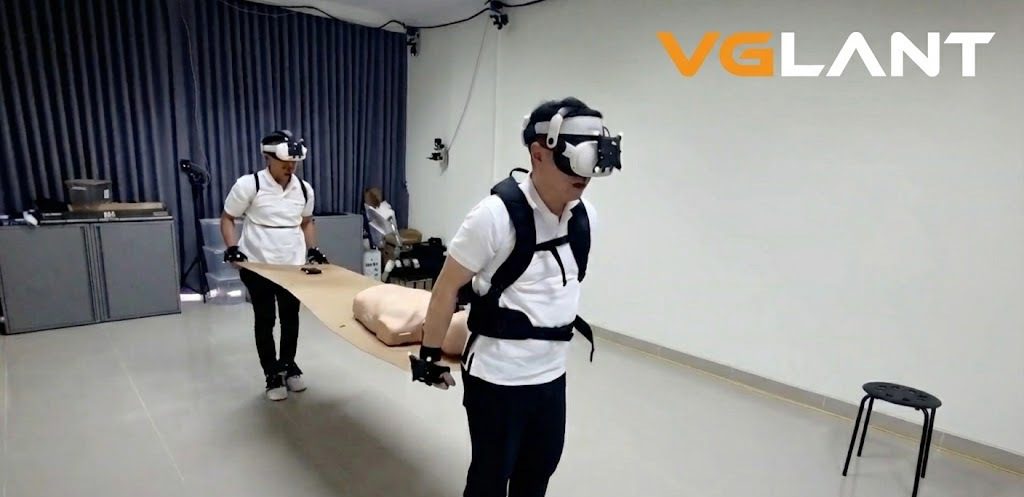
VGLANT’s first aid VR simulation is architecturally designed to maximize physical engagement at every stage of the emergency response sequence. Using motion-tracked controllers, the trainee performs the complete first aid response kinesthetically: approaching the virtual patient, kneeling beside them, checking for consciousness through verbal and physical prompts, tilting the head to assess airway patency, positioning hands on the sternum for chest compressions, delivering compressions through rhythmic arm movements, applying direct pressure to wound sites, and performing basic triage prioritization when multiple casualties are present.
Each of these actions engages the same motor pathways that would be activated during a real first aid response. The trainee’s proprioceptive system — the body’s internal awareness of limb position and force application — is actively involved in the learning process, creating motor memory traces in the basal ganglia and cerebellum that are neuroanatomically distinct from, and more durable than, the declarative memories created by watching a classroom demonstration.
Unlimited Repetition Without Material Constraints
VGLANT’s VR platform removes the practice volume ceiling that limits conventional first aid training. In a classroom setting, mannequin access is shared among 10 to 15 participants, and each individual receives two to three practice attempts. In VGLANT, the trainee has exclusive access to the virtual patient for the entire session duration. A single 30-minute VGLANT session can accommodate 15 to 25 complete CPR cycles, multiple wound management scenarios, and several triage decision exercises.
This repetition density is the critical variable for motor learning. Research by Schmidt and Lee (2011) establishes that progression from the cognitive stage through the associative stage to the autonomous stage of skill acquisition is primarily driven by practice volume. VGLANT’s ability to deliver 10 to 15 times the repetition volume of conventional training within a single session fundamentally alters the trajectory of motor competence development.
Contextual Scenario Variation
A distinguishing feature of VGLANT’s first aid module, aligned with what the platform describes as “contextual and personalized” training design, is the incorporation of randomized scenario variation. Each session presents different injury types, patient positions, environmental conditions, and complicating factors. This variation prevents the trainee from memorizing a single response sequence and instead develops adaptive motor competence — the ability to apply first aid principles flexibly across diverse emergency presentations.
For Indonesian industries where first aid emergencies span a wide range of injury types — crush injuries in mining, burn injuries in manufacturing, fall injuries in construction, chemical exposure in petrochemical operations — this contextual adaptability is operationally essential. Companies within the Virtu industrial network, managing operations across mining, energy, and manufacturing sectors, have recognized that single-scenario training produces workers who can respond to one type of emergency but freeze when confronted with an unfamiliar injury presentation.
VGLANT’s Trackable Performance System: Measuring Motor Competence Objectively
VGLANT’s integrated data tracking system measures motor competence with precision that instructor observation cannot match. For CPR performance, the system captures compression rate consistency (deviations from the 100–120 per minute target), compression depth accuracy, hand placement precision, and compression-to-ventilation ratio compliance. For wound management, the system tracks pressure application adequacy, bandage positioning accuracy, and triage decision correctness.
This objective measurement directly addresses a systemic weakness in Indonesian K3 first aid assessment, which typically relies on instructor observation and checklist-based evaluation. Subjective assessments are vulnerable to inter-rater variance, social courtesy bias (reluctance to fail colleagues), and temporal attention limitations (the instructor cannot simultaneously observe multiple performance dimensions). VGLANT’s automated telemetry provides a performance record that is objective, comprehensive, and auditable — meeting the documentation standards increasingly expected by Indonesian K3 auditors and international safety certifications such as ISO 45001.
Practical Implications for Indonesian Industry
The deployment of VGLANT’s first aid module carries specific practical advantages in the Indonesian operational context. First, the module can be deployed at remote industrial sites — mining concessions in Kalimantan, plantation operations in Sumatra, manufacturing facilities in Java’s industrial corridors — without requiring the presence of a certified first aid instructor for refresher sessions. The on-site HSE officer facilitates the VR session, while VGLANT’s standardized scenarios ensure consistent training quality regardless of location.
Second, the module’s zero-consumable operating model eliminates the recurring costs associated with mannequin replacement parts, bandage supplies, and training venue rental that characterize conventional programs. For Indonesian companies managing tight training budgets across multiple sites, this cost structure enables significantly higher training frequency — monthly or quarterly refresher sessions rather than annual-only programs.
Third, VGLANT’s performance data creates a longitudinal competence record for each employee, enabling HSE managers to identify competence degradation before it becomes a safety liability and to allocate refresher training resources precisely where the data indicates they are needed.
Conclusion
The motor practice deficit in conventional Indonesian first aid training produces workers who understand emergency procedures conceptually but lack the kinesthetic competence to execute them reliably under stress. VGLANT’s first aid VR simulation addresses this deficit through full-body motor engagement, unlimited practice repetition, contextual scenario variation, and objective performance telemetry. For Indonesian industries where the interval between training and emergency application may span months, and where remote locations demand autonomous first-responder capability from every worker, VGLANT’s kinesthetic training platform offers a measurable pathway from theoretical K3 compliance to genuine emergency motor competence.