The requests that reach KOMINA from police commands tend to circle the same worry. Their personnel can shoot fine on the range. They can recite the levels of force. What the commander isn’t sure about is the three seconds in a dark gang where an officer has to decide, with a crowd forming and a phone already recording, whether the man stepping toward him needs a verbal command, an empty-hand control, or something further up the ladder. The range never tested that. The classroom only described it.
That gap, between the mechanics an officer practices and the judgment the public actually holds him to, is the whole subject here. So before anyone demonstrates a headset, it’s worth being plain about what immersive training fixes and what it leaves untouched.
This is written for training divisions and command staff weighing the option. Not a sales sheet.
The Regulation, Briefly
In Indonesia, police use of force runs on Perkap No. 1 Tahun 2009 on the use of force in police actions, sitting alongside Perkap No. 8 Tahun 2009 on human rights standards in policing. The first document lays out the part everyone references: six escalating levels of force, from the mere presence of an officer, to verbal commands, to soft and then hard empty-hand control, to less-lethal options, with the firearm as the last rung and the last resort. Force is supposed to track the threat, and an officer reaching level 4, 5, or 6 has to file a written account of why.
What the doctrine specifies is the ladder and the duty to justify each step. What it cannot do, by its nature, is rehearse the officer in climbing that ladder correctly when the situation is ambiguous, fast, and emotionally loaded. A regulation describes the right answer. It does not build the reflex to reach it under pressure. That reflex is trained, or it isn’t, and most agencies have no honest measure of which.
Why the Decision Is the Hard Part
Marksmanship is a mechanical skill, and the range trains it well. Stance, grip, sight picture, trigger control. Measurable, repeatable, gradable.
The decision is a different animal. The hard moment in real policing is almost never “can I hit the target.” It is “is this even a level 6 situation, or did I jump three rungs because my heart rate was 160 and the man was shouting.” Under stress, perception narrows, hearing dulls, and time distorts. Officers misread hands. They escalate when a firmer voice would have ended it, or they freeze when they shouldn’t have. None of that is a character flaw. It is what an untrained nervous system does in a threat spike, and it is exactly the layer that range time and lecture slides do not touch.
You can teach the six levels in a morning. Teaching someone to apply them correctly while adrenaline is rewriting their senses is the part that takes repetition under something close to real conditions. And real conditions are precisely what you cannot safely manufacture.
Why Periodic Classroom and Role-Play Underperforms
Most agencies fall back on two things: a periodic refresher in a classroom, and occasional role-play with live actors.
The classroom has the same decay problem any perishable skill has. Judgment drilled once a year does not survive the year. Worse, the classroom teaches the decision as an abstraction, divorced from the stress that distorts it in the field.
Role-play is better, and KOMINA does not argue otherwise. But it’s expensive to stand up, hard to schedule across shifts, and quietly inconsistent. Two actors play the same scenario two different ways. The trainee often knows the script, or reads the instructor’s body language, or simply behaves for the camera. And the most important variants, the ones that go wrong, are the ones role-play is most reluctant to run, because nobody wants a defensive-tactics session to end in an actual injury. So the scenarios that matter most get softened or skipped.
That is the specific hole immersive training is good at filling.
What VR Actually Does Differently
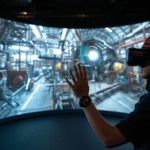
A KOMINA judgment module runs on a head-mounted display, in current deployments usually a Meta Quest 3 or a Pico 4. The officer stands inside a scenario rendered around him. A domestic call. A traffic stop that sours. An agitated person at a kiosk who may or may not be armed. The situation branches based on what the officer does, what he says, and when. Raise the voice too early and the subject hardens. Skip the verbal stage entirely and the system notes it.
The content is the doctrine itself, made experiential. The six-level ladder, the duty to choose proportionally, the de-escalation that should come before contact. What changes is that the officer now practices the decision, repeatedly, with the clock running and the scene reacting, instead of reciting it.
The scenario can also be allowed to go wrong on purpose, because nobody gets hurt when it does. The subject can comply, or flee, or turn out to be holding a phone rather than a weapon. The officer learns, in his body, the cost of a wrong read and the payoff of a held nerve. He can run that same encounter ten times in a week and watch his own pattern change.
And it logs everything. Time to first verbal command. Whether the response matched the threat level under Perkap 1/2009. Whether de-escalation was attempted before force. That is accountability and competency data a training division can actually put in front of a Propam review or an internal audit, rather than an attendance sheet and a hope.
Research on simulation-based judgment training for police and emergency responders generally points the same way: better retention and better decision consistency than lecture-only methods, mostly because the repetition is cheap, frequent, and pressured. The single-session effect is modest. The operational win is the reps.
Where VR Fits, and Where It Doesn’t
A few honest boundaries.
VR does not replace the live-fire range. Putting rounds downrange is a physical, certified competency. The headset trains the decision to draw, not the mechanics of the shot. Serious programs run both.
VR does not replace physical defensive tactics. Control holds, restraint, and the feel of a real struggle are muscle and contact. A controller cannot teach that. Keep the mat work.
VR does not certify anyone. Accredited instruction and the formal qualification path still apply. The headset lives between those, in the refresher and judgment space where conventional methods are weakest.
Where it earns its place:
- Large commands where standing up consistent role-play across every shift is a recurring headache
- De-escalation and judgment, where the whole point is the decision rather than the mechanics
- Agencies that need defensible, repeatable competency and accountability data, not just a signed register
- Stress exposure that is safe, controlled, and identical for every trainee
Where it probably isn’t the priority:
- A small unit whose real problem is that nobody is current on the basic legal framework at all. Fix that first.
- Any command expecting a headset to substitute for live-fire or physical training. It won’t, and selling it that way sets up the rollout to fail.
KOMINA Specifics
KOMINA (Komando Imersif Indonesia) is built by PT Virtu Digital Kusuma, an Indonesian AR, VR, MR, and Digital Twin company with offices in Jakarta and Bandung. The judgment module is one part of a broader immersive catalog for security and defense training. The shared platform matters at procurement time: the same headsets run more than one program, which is the argument that gets a budget owner to sign off on hardware rather than seeing it as single-use.
A few things worth flagging. Voice prompts and the interface are in Bahasa Indonesia by default. Scenarios, uniforms, environments, and the level-of-force logic are modeled on Indonesian policing and Perkap doctrine, not imported wholesale from a foreign system where the legal ladder is different. That sounds cosmetic until a trainee hesitates because the on-screen procedure doesn’t match what his own SOP requires. Support is local and in the same timezone, which stops being a minor point the first time a deployment-day issue needs solving and the vendor isn’t asleep on the other side of the world.
Cost Realities
Headset hardware in Indonesia currently runs roughly IDR 7 million to IDR 25 million per unit, depending on whether the buy is consumer Quest 3 devices or enterprise units with management software. Content and scenario licensing sits on top, usually per seat or per site on annual terms.
The comparison that matters is against the real cost of consistent role-play: actors, instructor hours, venue, scheduling across shifts, and the simple fact that you cannot safely run the worst-case scenarios live. For a large command already paying for recurring scenario training, breakeven tends to land inside the first couple of years, and sooner if the goal is frequent refreshers, because frequent role-play is exactly the thing that gets unaffordable.
The sensible entry is a pilot. Five to ten headsets, one unit, two or three months, measured against the current method. Buying fifty headsets for a workflow nobody has tested with your own personnel and your own SOP is how procurement ends up owning an expensive shelf.
What to Nail Down Before Signing
For any immersive training vendor, not only KOMINA, settle these before the contract closes.
Doctrinal alignment. Confirm the scenario logic follows Perkap 1/2009 and your command’s own SOP, so you aren’t training a slightly foreign version of the use-of-force ladder.
Data into your records. Decide where the session and competency data lives, who can review it, and how it feeds accountability processes. Not a vendor portal nobody opens after the first quarter.
Scenario localization and debrief. The value is in the after-action review. Make sure the system supports a proper debrief, ideally instructor-led, not just a score screen.
Data ownership and residency. Training and competency records on personnel are sensitive. Sort out where they are hosted and who owns them early, not after signing.
For technical specifications, pilot scoping, or a platform walkthrough, KOMINA can be reached through PT Virtu Digital Kusuma at komina.co or +62 818 0755 5538.