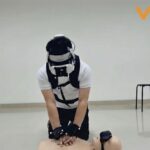
Put on a headset. Pick up the controllers. The room around you disappears, replaced by something operationally specific — an urban entry point, a parachute deployment altitude, a vehicle interior, a hostage room, a command station. What happens next looks similar to what would happen during a real operation. The trainee acts. The system records. A debrief follows. That’s the basic shape of virtual training as it’s currently deployed across defense and security organizations.
This piece is a working reference on how that actually works. What it drills, where it sits within the broader training pipeline, what it can and can’t do, and what serious programs look like operationally. Less an overview, more a practical examination for organizations evaluating the technology.
What conventional training delivers, and where it doesn’t
Military and law enforcement training has a well-developed conventional toolkit. Classroom education on doctrine, tactics, and rules of engagement. Live-fire ranges where weapons handling becomes muscle memory. Field training exercises that build resilience in real conditions. Tactical drills with role-players. Specialized facilities — close quarters battle (CQB) houses, parachute towers, vehicular operations courses — that handle scenarios needing dedicated infrastructure.
This toolkit works. Operational forces have used it for decades, and the personnel it produces perform competently across the operations they face. The question isn’t whether conventional training is effective. It’s whether conventional training, on its own, fully prepares personnel for the operational range they actually encounter.
Several constraints answer that question.
Risk is intrinsic to live training. Personnel handling actual weapons, operating actual vehicles, executing actual high-risk maneuvers face physical danger. Safety protocols manage the risk. They also limit what can be safely practiced. The scenarios most dangerous in real operations are the same scenarios most difficult to drill safely in live conditions.
Cost scales with realism. Live combined arms exercises burn through ammunition, fuel, vehicle wear, range fees, and instructor hours. Specialized infrastructure for urban warfare, high-altitude scenarios, or maritime operations is expensive to build and limited in availability. Most organizations face hard ceilings on how often they can run their most realistic exercises.
Some scenarios resist physical replication entirely. Hostage rescue with hostile combatants present. Mass casualty events. HALO and HAHO insertions in adverse weather. Vehicle-borne IED response in urban density. These scenarios share two characteristics — they’re the ones personnel most need to be ready for, and they’re the ones live training has the hardest time providing.
Skill retention sits behind all of it. Tactical procedures, weapons handling sequences, communication protocols, decision-making patterns — perishable. Without consistent practice, performance degrades. Annual or semi-annual exercise cycles satisfy doctrine. They don’t match the practice frequency required to keep a unit operationally sharp across the full range of scenarios it might face.
These constraints aren’t arguments against conventional training. They’re factors that conventional training, used alone, can’t fully address. Virtual training enters the picture at exactly these points.
How a virtual training session actually runs
Walk through what a session looks like in practice.
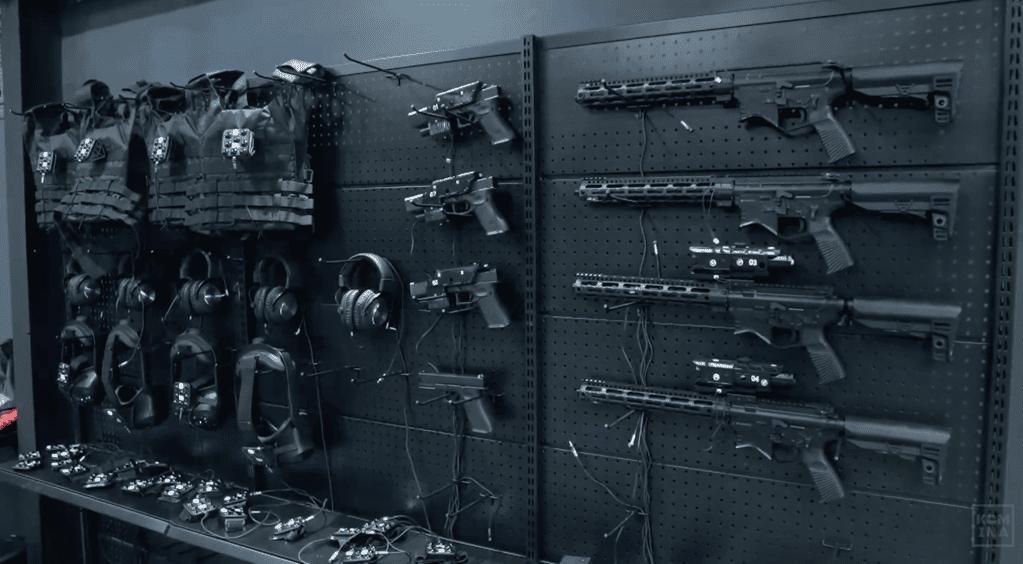
The hardware setup is fairly standardized. A head-mounted display drives the visual environment. Current deployments commonly use Meta Quest 3 with managed enterprise software for general scenarios, HTC Vive Pro and Pico Enterprise for managed deployments, and Varjo XR for scenarios needing photorealistic visual quality. Motion controllers track hand position and orientation. Optional accessories layer in additional fidelity — weapon-form props with embedded tracking sensors, full-body tracking, motion platforms for vehicular and aerial scenarios, haptic vests delivering impact and directional cues.
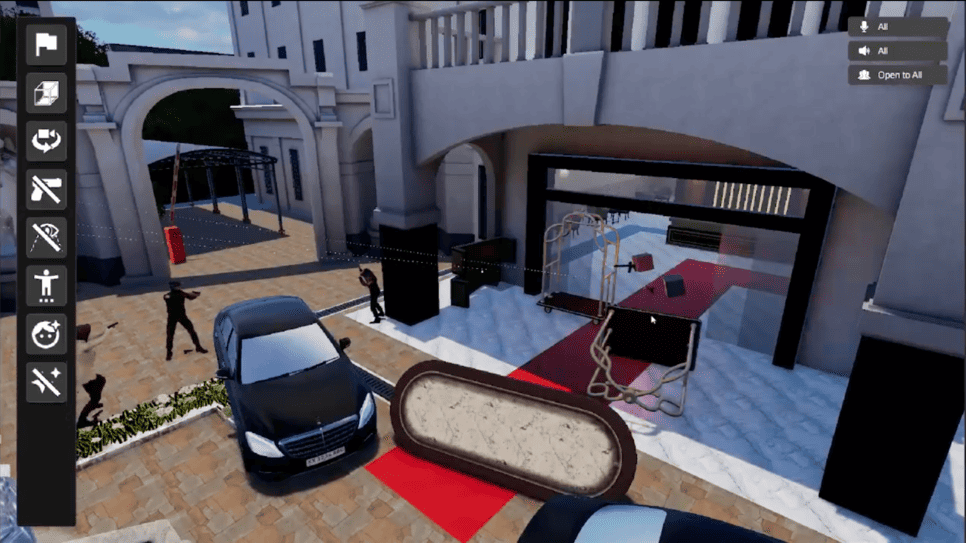
The trainee enters a simulated environment built for the scenario type. Urban environment for CQB practice. Aircraft cabin for hostage rescue rehearsal. Vehicle interior for driving operations. Open terrain for parachute insertion. Command center for coordination scenarios. Visual fidelity matters here — lighting, ballistics behavior, environmental effects, physics. All rendered to match real-world conditions.
The scenario begins. Personnel act as they would on operations. Weapons handling, movement discipline, communication, target identification, threat assessment, engagement decisions — all happening in real time, all tracked. Where the trainee looks, how they position themselves, what they communicate, the timing of every decision — captured by the system.
The scenario ends. The debrief follows. Performance scored against doctrine and rules of engagement. Decisions evaluated. Errors identified specifically rather than generally. Feedback covers weapons handling, movement, communication, and judgment. The trainee can replay the scenario, adjust variables, or move to different scenarios that build on what just happened.
It’s the same learning loop as other procedural training. The difference is that virtual training delivers the loop in scenarios where physical practice is constrained by safety, cost, or feasibility.
The neurological case for immersion
Virtual training works for reasons that go beyond convenience. Specific properties of immersive environments produce measurable training effects that classroom or video-based training doesn’t.
When the brain treats the simulated environment as sufficiently real — what researchers call presence — it generates physiological and cognitive responses similar to those produced by actual events. Stress hormones rise. Heart rate elevates. Working memory comes under load. Decision-making operates under conditions closer to real engagement than abstract instruction can produce.
Two specific training effects follow from this.
Stress inoculation is the first. Personnel who’ve rehearsed under simulated stress perform measurably better when actual stress arrives. The effect is documented across military training research, sports performance science, and emergency response literature. The mechanism is neurological — repeated controlled exposure to stress responses builds the brain’s capacity to maintain executive function under high-arousal conditions. Virtual training delivers controlled stress exposure at a frequency live exercises can’t sustain.
Muscle memory development is the second. Repeated execution of weapons handling sequences, movement patterns, and procedural drills under realistic conditions builds reflexive responses. Research on procedural skill retention consistently shows better outcomes in immersive environments than in lecture or video-based training. The mechanism isn’t complicated. The body learns by doing, not by being told what to do.
Skill transfer from virtual to real operations has been the central research question for military virtual training over the past decade. Published work on weapons familiarization, tactical decision-making, and crisis response generally reports positive transfer when scenario design is sound. Transfer isn’t perfect — there’s always a gap between any simulation and reality — but it’s reliable enough that operational forces in multiple countries have integrated virtual training into their pipelines.
Where virtual training fits in law enforcement
For police organizations, virtual training addresses scenarios that conventional methods struggle to drill at sufficient depth or frequency.
Crisis intervention and de-escalation. Officers practice verbal de-escalation, body language management, and graduated response across scenarios involving emotionally distressed subjects, mental health crises, and domestic disputes. The cognitive demand of these encounters — reading micro-expressions, modulating tone, holding presence under verbal pressure — is hard to replicate in classroom role-play with colleagues.
Use of force decision-making. Shoot/don’t-shoot scenarios under time pressure, with ambiguous threat indicators, multiple bystanders, and situations evolving moment to moment. The training drills both the mechanical sequence of weapons handling and the judgment layer that determines when force is appropriate. The two reinforce each other in ways neither develops alone.
Hostage situations. Negotiation under pressure, tactical entry coordination, hostage extraction, post-incident management. Operationally rare events. Consequential when they happen. Conventional training rarely provides enough repetition for personnel to develop the pattern recognition that real hostage response demands.
Crowd control and demonstration management. Reading crowd dynamics, communication with command, escalation thresholds, coordinated unit movement. Live exercises replicate some of this. Virtual training adds variant frequency that live exercises can’t match cost-effectively.
Active threat response. Building entry protocols, threat suppression, casualty management, coordination with arriving units. The cognitive demand of an active scene is precisely what conventional training has the hardest time producing.
Investigation procedure. Evidence preservation, witness interview technique, scene documentation. Less time-critical than tactical scenarios. Equally dependent on procedural discipline that builds through repetition.
Force continuum application. Officers practice graduated response across the full range of permissible force levels, building familiarity with when each level applies and how to transition between them under operational pressure.
Where virtual training fits in military operations
For military forces, virtual training supports several operational training categories.
Small unit tactics and combat readiness. Squad and team movement drills, room clearing, urban combat scenarios, coordinated engagements. Trainees practice weapons handling, tactical communication, and movement discipline in scenarios that can be replayed across different layouts, threat configurations, and complications.
Individual marksmanship and weapons familiarization. Service weapons proficiency, including international platforms used in joint operations. Trainees develop fundamentals on weapon-form props before live-fire range time. The savings extend beyond ammunition — the safety risk of live training on weapons personnel haven’t practiced is one of the underappreciated benefits of pre-range virtual practice.
Vehicular operations. Armored vehicle crew training, tactical driving, convoy operations, response to vehicular threats. Motion platforms paired with virtual environments simulate vehicle dynamics in ways static trainers can’t approximate.
Airborne operations. HALO and HAHO insertions, exit sequences, freefall management, canopy control, landing procedures. Live training is inherently dangerous in this category. Pre-jump rehearsal in simulation is where extensive practice actually happens.
Maritime and amphibious operations. Boat handling, beach insertion, vessel boarding, maritime interdiction. Weather-dependent and resource-intensive in live training. Both constraints get addressed by virtual training.
Command center coordination. Tactical operations center procedures, situation awareness management, multi-unit coordination, decision-making under information ambiguity. Senior personnel rehearse command and control scenarios that mirror real operational complexity.
Mission-specific rehearsal. Detailed simulation of upcoming operations using terrain data, building schematics, and known threat parameters. Personnel rehearse the actual mission before execution. Coordination gaps surface in advance. Contingencies get practiced before they’re needed.
The hardware and software stack
Current generation virtual training platforms combine several integrated components.
Display hardware spans a range. Consumer-grade headsets like Meta Quest 3 handle general scenario practice. Enterprise systems including HTC Vive Pro and Pico Enterprise serve managed deployments. High-fidelity systems like Varjo XR handle scenarios requiring photorealistic visual quality. The choice tracks scenario requirements, available budget, and the precision of visual identification the training demands.
Motion controllers manage general interaction. For weapons training, weapon-form props with embedded tracking sensors deliver proper weight, balance, and ergonomics. The props match the dimensions and feel of actual service weapons, which is precisely what makes muscle memory developed in simulation transferable to live equipment.
Haptic feedback extends sensory range beyond visual and auditory. Vests deliver impact and directional cues. Gloves provide grip and tactile sensation. Motion platforms simulate vehicle and aircraft dynamics. The trade-off is between added realism and equipment cost. Serious deployments calibrate hardware investment to actual training value rather than buying everything available.
Software handles scenario generation, AI-driven non-player characters (NPCs), environmental variables, and performance tracking. Modern platforms let scenarios adapt based on trainee actions — NPCs respond more realistically, environmental conditions shift mid-scenario, complications layer in dynamically. Scenario builder tools let instructors construct custom training without writing code.
Performance analytics aggregate session data into individual and unit-level reports. Time-to-decision. Accuracy. Procedural compliance. Communication quality. Tactical movement patterns. Tracked across sessions, compared over time. Commanders and training officers use the data to identify gaps and target additional practice where it produces value.
What virtual training doesn’t claim to do
Worth being direct about the limits.
Virtual training doesn’t replace live-fire training. The physiological and procedural elements of actual weapons firing — recoil management, ammunition handling, weapons maintenance, range discipline — need live practice. Virtual training builds the fundamentals that make live training safer and more efficient. It doesn’t substitute for time on the range.
It doesn’t replace field training exercises. Operating in actual terrain, weather, and physical conditions develops resilience and judgment that simulation can’t fully reproduce. Fatigue, environmental exposure, and physical demands of real operations remain a separate training domain.
It doesn’t replace accredited specialized training. Pilot certification, parachute qualification, dive certification, and similar specialized courses run through accredited programs operated by service training commands. Virtual training functions as a complement to these programs, not as an alternative path.
It doesn’t replace command experience. Senior decision-making under real operational pressure, with real lives and real resources at stake, develops over time and across actual operations. Simulation supports the preparation. It doesn’t substitute for the experience.
Virtual training works as one layer within a broader training program. It covers what it covers well — repeatable scenario practice, controlled stress exposure, performance measurement, scenarios that can’t be physically staged — and doesn’t cover what it doesn’t. The mistake to avoid is treating it as a complete training program in itself.
Ethical and operational considerations
Two areas worth flagging directly.
Psychological impact. Repeated exposure to stress scenarios, including those involving simulated violence or trauma, can affect personnel over time. Serious virtual training programs build in trauma-informed design — clear pre-scenario briefings, voluntary pause and exit options, post-scenario debriefing, access to support resources. These aren’t optional features. They’re how responsible programs operate.
Desensitization. Repeated exposure to violence in any training format can affect emotional response. The mitigation runs through scenario design that maintains the gravity of force decisions, debriefing that examines decisions ethically rather than only tactically, and integration with broader training on rules of engagement, proportionality, and ethics. Well-designed virtual training reinforces these dimensions rather than eroding them.
Both considerations apply equally to conventional and virtual training. The technology doesn’t introduce new ethical questions. It does require deliberate program design to handle existing ones responsibly.
Technical and human limitations
Current virtual training systems have practical limits worth acknowledging.
Motion sickness and physical discomfort. A subset of users experience nausea, headache, or eye strain during prolonged sessions. Modern hardware has reduced this substantially, and session design that includes breaks helps further. The issue isn’t fully eliminated.
Hardware constraints. Display resolution, field of view, and tracking precision keep improving. Current generation hardware still has limits compared to actual operational visibility. Certain visual identification tasks, especially at long range or in low light, remain harder in virtual training than in live conditions.
Instructor learning curve. Integrating virtual training into existing curricula requires instructors capable of configuring scenarios, interpreting performance data, and conducting effective debriefings. The learning curve is real, particularly for instructors new to the technology. Serious programs invest in instructor preparation before deployment, not after.
Generational adoption variance. Younger trainees adapt to virtual training quickly. More senior personnel may need additional onboarding. This isn’t a barrier to deployment. It does affect rollout pace.
None of these are arguments against virtual training. They’re factors that affect deployment effectiveness, and they’re addressable through program design that takes them seriously.
What’s coming next
Two technology directions are worth noting briefly.
Hybrid live-virtual integration. Virtual training is increasingly being combined with live exercises in single integrated training events. Some elements happen physically. Others happen in simulation. Both feed into the same scenario. Live exercises can incorporate scenarios that would be too dangerous, expensive, or impossible to stage entirely live.
Performance analytics depth. Session data is becoming richer over time, with finer-grained measurement of decision-making, communication, and tactical execution. The data supports both individual development and unit-level performance management in ways conventional training records can’t produce.
Whether longer-horizon technologies like full-body haptics or brain-computer interfaces become operationally relevant remains a separate question. The shorter-term reality: current virtual training hardware and software are already capable of supporting serious training programs. The operational priority is deploying what already works effectively, not waiting for what doesn’t yet exist.
KOMINA virtual training capabilities
KOMINA — PT Komando Imersif Indonesia — develops virtual training systems for military and law enforcement organizations. The platform is built around scenario-based training across the categories most operationally relevant to defense and security work.
Single Combat covers individual weapons proficiency, marksmanship, and engagement decision-making across service weapons inventory. Trainees develop fundamentals on tracked weapon-form props before live range time.
Team Combat covers small unit tactics, room clearing, coordinated movement, and communication under pressure. Squad-level scenarios run in environments matched to actual operational settings.
HALO and HIHO modules cover high-altitude parachute insertion training, including exit sequence, freefall management, canopy deployment, and landing procedures. These scenarios provide extensive rehearsal opportunity for operations that are inherently high-risk in live training.
Vehicular Battle covers armored vehicle crew operations, tactical driving, convoy procedures, and response to vehicular threats. Motion platforms paired with the system simulate vehicle dynamics for realism beyond static trainers.
Command Center covers tactical operations center procedures, situation awareness management, and multi-unit coordination. Senior personnel rehearse command and control scenarios with realistic information flow and decision pressure.
Custom Projects address specific operational requirements outside the standard module set. Mission-specific rehearsals, specialized scenarios, and integration with existing training infrastructure are scoped on a per-project basis.
The platform is built in Indonesia for the operational requirements of defense and security organizations operating in Indonesian and regional contexts. Scenarios reflect locally relevant environments, terrain, equipment, and doctrinal references. Voice prompts and UI default to Bahasa Indonesia, with English available for joint exercises and regional cooperation. Performance data is logged for unit-level review and integrates with existing training records.
For capability briefings, scenario scoping, or pilot deployments, KOMINA can be reached at https://komina.co/ or +62 812 9696 7887.