Using a portable fire extinguisher correctly involves two decisions. The first is whether the fire is small enough to fight at all. The second is whether the extinguisher at hand is suitable for the type of fire. Both depend on knowledge that many workers learn only once, in a classroom, and rarely apply. This article covers the basics of fire classes and extinguishing agents and explains how VR training can help workers practise using them.
How Fire Starts and Spreads
Fire needs three elements: heat, fuel and oxygen. This is often called the fire triangle. A fourth element, the chemical chain reaction that sustains burning, is added in the fire tetrahedron model. Removing any of these elements stops the fire.
Extinguishing agents work by removing one or more of these elements. Water cools the fuel. Foam and carbon dioxide separate the fuel from oxygen. Dry chemical powder interrupts the chemical reaction.
Fire Classes in Indonesia
In Indonesia, fire classes for portable extinguishers are set out in Minister of Manpower Regulation No. PER.04/MEN/1980 on the installation and maintenance of portable fire extinguishers (APAR). The regulation uses four classes:
- Class A: fires involving ordinary solid materials such as wood, paper, cloth and some plastics.
- Class B: fires involving flammable liquids and gases.
- Class C: fires involving live electrical equipment.
- Class D: fires involving combustible metals.
Some international standards also include a separate class for cooking oils and fats, such as Class K in the United States or Class F in parts of Europe and Australia. Companies operating to international standards may see these classes on extinguisher labels.
Common Extinguishing Agents
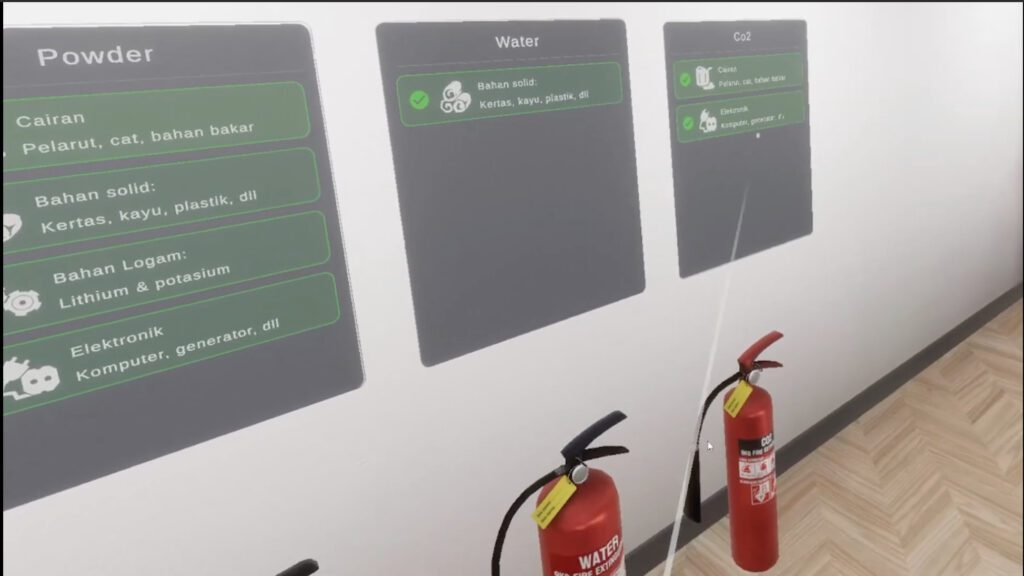
Each extinguisher type is suitable for some fire classes and unsuitable for others:
- Water: for Class A fires. Not suitable for electrical fires or flammable liquids.
- Foam: for Class A and B fires.
- Carbon dioxide (CO2): commonly used for Class B and electrical fires. It leaves no residue, which is useful around equipment.
- Dry chemical powder: multipurpose types can be used on Class A, B and C fires.
- Special agents: specific products are used for metal fires and cooking oil fires.
The extinguisher label shows which classes it is rated for. Workers should check the label before use.
The PASS Technique
The PASS technique is a widely taught method for operating a portable extinguisher:
- Pull the safety pin.
- Aim the nozzle at the base of the fire.
- Squeeze the handle to release the agent.
- Sweep the nozzle from side to side across the base of the fire.
Training should also cover when not to fight a fire: for example, when the fire is spreading quickly, when smoke is filling the area or when the escape route is threatened.
Why Classroom Training Is Not Enough
Classroom sessions explain fire classes and agents, but workers may not remember them under pressure. Practical sessions with real extinguishers are valuable, but they use extinguishers, require a safe outdoor area and usually allow each participant only one attempt.
How VR Fire Training Helps
VR training places workers in a simulated environment where they can identify a fire, select an extinguisher and apply it. VGLANT’s fire extinguisher training covers three areas listed on its product page:
- Basic fire knowledge, including the fire chain
- Fire extinguisher agents
- A standardised extinguishing procedure
Because the fire is simulated, workers can practise many times without using real extinguishers or creating smoke. Scenarios can include different fire types, so workers must choose an appropriate extinguisher rather than repeat the same action.
VGLANT’s platform records each user’s results, and an admin dashboard presents performance data in visual charts. Supervisors can see which workers chose an unsuitable extinguisher or skipped steps in the procedure.
What VR Cannot Replace
VR does not reproduce the weight, heat or noise of a real extinguisher discharge. Hands-on practice with real equipment, regular inspection of extinguishers and compliance with local fire regulations remain necessary.
Summary
Knowing fire classes, matching extinguishers to fires and applying the PASS technique are core skills for workplace fire response. VR training allows workers to practise these decisions repeatedly and gives supervisors a record of each attempt. Organisations interested in VR fire extinguisher training can contact VGLANT for a demonstration.